
Honoring Resilience on the Anniversary of 9/11:
Bruno Surdo’s
Tragedy, Memory and Honor
oil on canvas, 9 x 35 feet
Bruno Surdo 9/11 Memorial Painting: Tragedy, Memory and Honor, Video by Jim Kopp
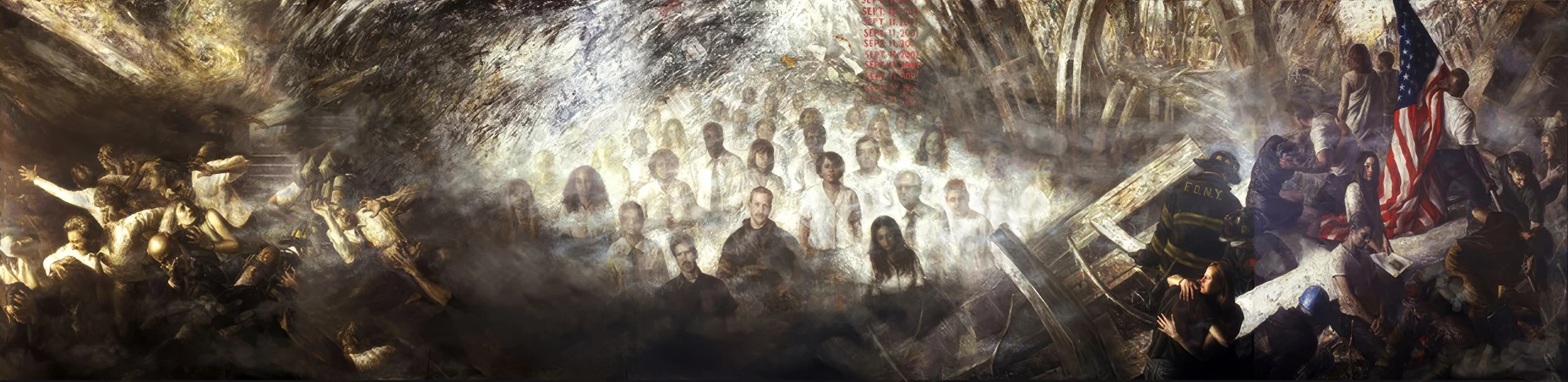
Bruno Surdo, Tragedy, Memory and Honor, oil and mixed media on canvas, 9 feet x 35 feet
Gallery VICTOR is honored to present Honoring Resilience, a special exhibition commemorating the 25th anniversary of September 11, 2001, centered on Bruno Surdo’s monumental painting Tragedy, Memory and Honor.
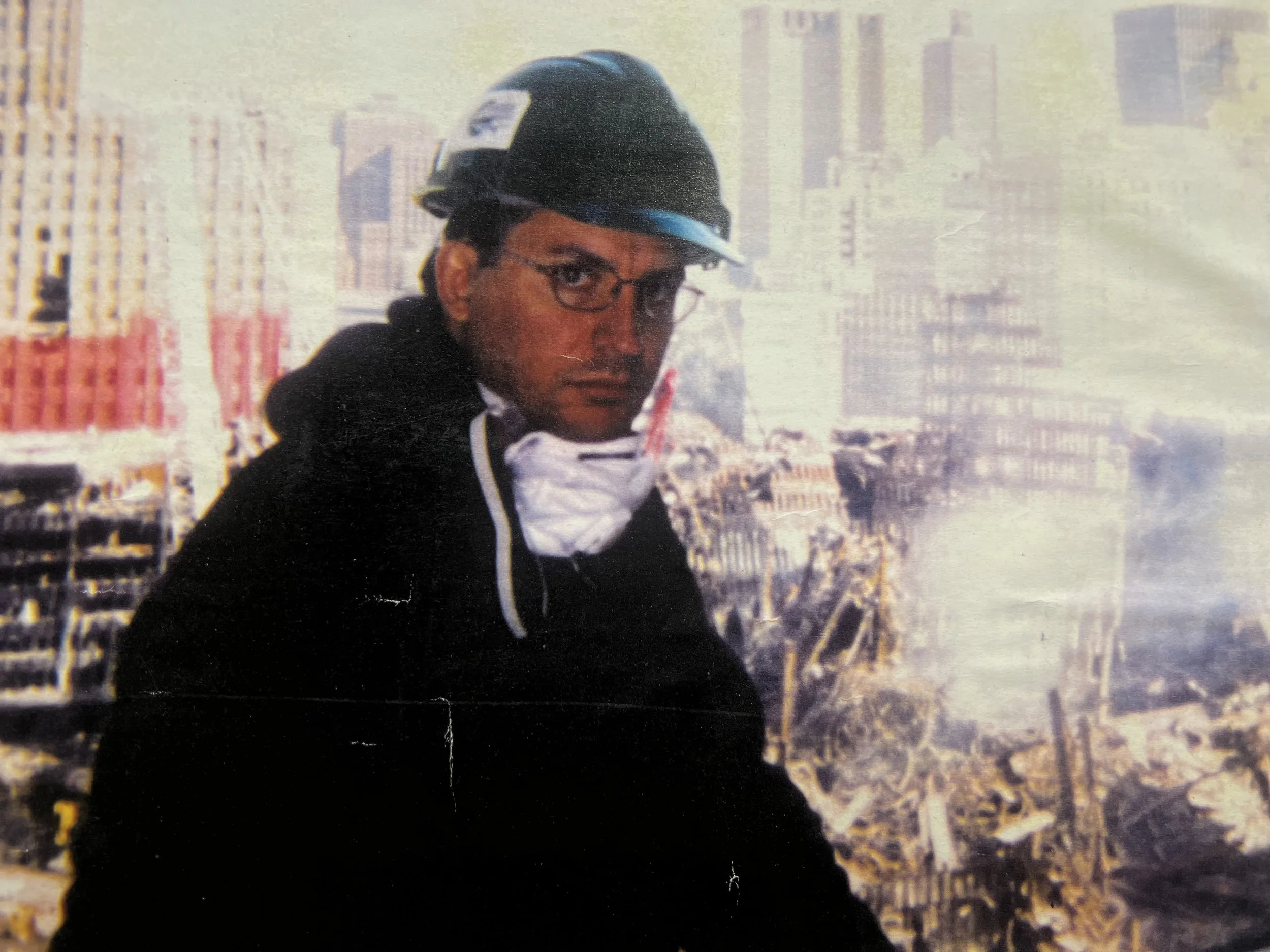
Bruno Surdo at Ground Zero, 2001
Tragedy, Memory and Honor is one of Surdo’s most powerful and historically significant works. The five panel artwork measures 9 x 35 feet. Created in response to the events and aftermath of 9/11, the painting stands as a profound meditation on loss, courage, mourning, and the endurance of the human spirit. Through its sweeping scale and emotional force, the work invites viewers into a space of remembrance and reflection while honoring the lives forever changed by that day.

detail, Tragedy, Memory and Honor
Bruno Surdo is a celebrated Chicago artist known for his large-scale narrative figurative paintings and his sustained commitment to the human condition as a subject of contemporary art. Represented by Gallery VICTOR, Surdo has exhibited widely over several decades, and Tragedy, Memory and Honor has previously been shown in Chicago, including at the Daley Center in 2002 and 2003, as well as in galleries across the country. In recognition of the painting, Surdo received a letter of appreciation from former Mayor Richard M. Daley.
This exhibition will extend beyond the painting itself. In addition to Tragedy, Memory and Honor, the presentation will include artifacts from Ground Zero collected by the artist while assisting in cleanup efforts two weeks after 9/11, along with a video documenting the creation of the painting, preparatory drawings and sketches, photography, testimonials, and historical materials. Together, these elements will provide visitors with a deeper understanding of the work’s creation, its historical context, and its lasting emotional impact.
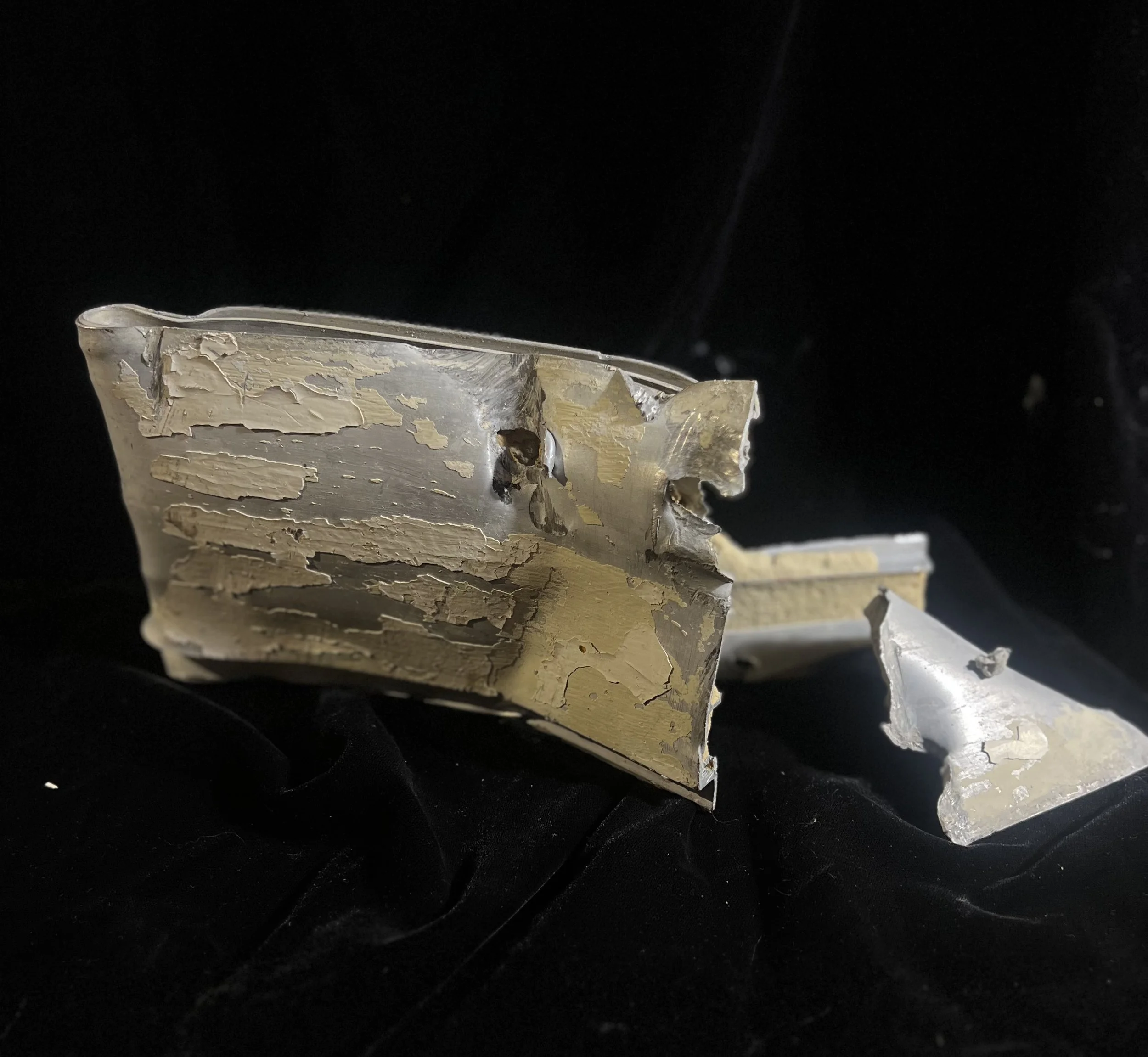
Fragment from the World Trade Center’s Twin Towers
Presenting this exhibition in Chicago carries special meaning. As Surdo’s hometown, the city provides a powerful context for revisiting a work that has moved audiences nationwide. Gallery VICTOR’s historic setting offers an ideal venue for an exhibition of this scale and significance, giving viewers the opportunity to engage with a work that is not only a monumental achievement in contemporary figurative painting, but also a testament to collective memory, resilience, and compassion.
More than two decades after 9/11, Tragedy, Memory and Honor remains a deeply relevant and moving work, reminding us of art’s capacity to preserve history, bear witness to suffering, and honor the strength of those who endure.
The exhibition will premiere during the 10th Annual River North Design District Fall Gallery Walk on Friday, September 11, 2026, from 5 to 8 PM. This special evening will offer the public its first opportunity to experience Surdo’s monumental work at Gallery VICTOR on the 25th anniversary of 9/11.
ORAL HISTORY
Bruno Surdo
Bearing Witness Through Paint
A narrative adaptation about the making of Tragedy, Memory and Honor
followed by an edited Q&A transcript
"I felt I was on a mission, and I had to do it in a certain way or I would have failed."
- Bruno Surdo
Prepared from a recorded conversation between Bruno Surdo and Gallery VICTOR | August 2026
Editorial note
This document contains two treatments of the same conversation. Part I is a narrative adaptation written from Surdo's account. The work's title and clear institutional names have been standardized as Tragedy, Memory and Honor, Ground Zero, the Daley Center, and Gallery VICTOR. A few personal names and venue details from the rough transcript have been generalized.
Part II is a lightly edited Q&A transcript: false starts, repeated words, and obvious speech-recognition errors have been removed for clarity, while Bruno Surdo's meaning, sequence, and first-person voice have been preserved. It is not a word-for-word legal transcript. Victor from Gallery VICTOR was the interviewer.
Part I | From an interview with Bruno Surdo
Bearing Witness Through Paint
Bruno Surdo and the making of Tragedy, Memory and Honor
Fourteen days after September 11, 2001, Bruno Surdo boarded a plane in Chicago for New York. Air travel was frightening then, and the ruins of the World Trade Center were still an active recovery site. Surdo nevertheless felt that if he was going to respond as an artist, he needed to move beyond the images on television. He wanted firsthand knowledge - not to satisfy curiosity, but to give a work he had not yet conceived the weight of lived experience.
Through relatives and members of a construction crew, Surdo made his way into Ground Zero. In his telling, it was not a normal or officially sanctioned visit. Workers placed him on a crew list, gave him protective equipment, concealed him when necessary, and guided him through damaged buildings and controlled areas. He moved debris alongside firefighters, EMT personnel, first-aid workers, and laborers. He gathered fragments from the site and listened as people described what they had seen and whom they had lost.
He remained there from roughly seven in the morning until six at night. The physical scale stunned him: twisted structures, dust, collapsed interiors, and an expanse of debris that television had flattened into an image. More enduring, however, were the human details. He remembers the faces of exhausted workers, the families brought through the site, and the respectful circles that formed whenever remains were recovered. He remembers sitting alone in damaged rooms while waiting to move to another area. Above all, he remembers the smell - an impression that fixed the day in his senses long after he returned home.
Before the trip, Surdo knew only that he wanted to make a work about 9/11. Ground Zero changed its center of gravity. The painting would not be primarily about spectacle or destruction. It would honor the victims, the people who searched for them, and those who continued working amid grief. He began to imagine a monumental composition organized around three narrative movements: the attack and its rupture, the human loss at the center, and the aftermath carried by survivors and responders.
Surdo spent three days in New York, but the experience followed him back to Chicago for months. He rented a new studio large enough for the undertaking and began to research, draw, and plan. Preparatory studies helped him establish the scale and find the figures and motifs that could hold the story. The work that emerged, Tragedy, Memory and Honor, became a monumental, multi-panel painting whose size demanded physical as well as emotional endurance.
The figures were built from life, but Surdo deliberately avoided copying the faces of actual victims. Instead, he invited firefighters, friends, relatives, and strangers to pose. He searched for people who could evoke the breadth of lives lost while protecting the privacy and dignity of their families. The model sessions became acts of shared remembrance. He asked each person not simply to hold a pose, but to bring an awareness of the time into the studio. Support arrived in unexpected ways. When Surdo saw a flag outside a stranger's home that felt right for the final section, he knocked on the door and asked to borrow it. The owner agreed.
For about five months, Surdo worked with an intensity that isolated him from ordinary life. The paint became a record of his physical struggle with the subject. He laid down heavy passages with spatulas and rollers, threw paint, and mixed pigment with dust. The process was forceful, even violent. The material accumulated beneath his fingernails as grief and anger accumulated in the image.
The cost was severe. Surdo withdrew from family and friends and became depressed. Near the painting's completion, he experienced a panic attack and what he describes as a partial breakdown. In a moment of frustration, he hurled his brushes at the canvas. He worried about his health and wondered whether he would ever be able to undertake such a work again. The painting may have fulfilled his artistic mission, but it did not release him from the experience that produced it.
When the work was first presented at Chicago's Daley Center, it received civic attention, press coverage, and recognition from Mayor Richard M. Daley. Yet the public setting also brought an unexpected disappointment. Surdo sometimes sat nearby and watched office workers hurry past without looking. To him, the painting contained months of labor and the emotional force of Ground Zero; in a busy lobby, it could become background. The gap between what he had poured into the work and what a passing viewer might see was painful.
Other exhibitions offered different encounters. The painting appeared at Ann Nathan Gallery and traveled to venues in Fort Wayne, Arkansas, Wisconsin, and Grand Rapids. Firefighters and other viewers often responded with visible emotion. Some places offered substantial attention, while others provided little press or context. Surdo continued to hope that the work would be shown in New York, but its scale and the rawness of its subject made an appropriate venue difficult to secure.
Now, as the twenty-fifth anniversary of 9/11 approaches and the painting returns to view at Gallery VICTOR, Surdo feels both pride and apprehension. He has not stood before the fully installed work in years. To see it again will mean confronting not only the history it depicts, but also the private history of its making. The finished image honors collective loss; beneath its surface lies the artist's own exhaustion, anger, grief, and sense of duty.
Surdo hopes Tragedy, Memory and Honor will eventually find a permanent home with an audience willing to spend time with it. He sees it as part of the historical record: one artist's response, made while the catastrophe was still raw, alongside the photographs, films, documents, and other artworks through which later generations will encounter September 11. Its purpose is not to contain the event - no single work could - but to bear witness and to keep memory visible.
Part II | Edited Q&A Transcript
VICTOR: What compelled you to make this work, and why did you go to New York?
Bruno Surdo: Two weeks after 9/11, I felt compelled to make a work of art. I wanted to bring authenticity to it, so I flew from Chicago to New York at a time when everyone was afraid to travel. Through relatives and construction workers, I was able to approach Ground Zero. One relative was working in the excavation and said he might be able to get me inside. With help from union workers, support crews, and a supervisor, I was brought in through the side and moved from place to place until I reached the site itself. I was not there through an ordinary public permission process; people hid me in corners and guided me through different channels. Once inside, I witnessed the devastation, helped move debris, gathered materials from the site, and spoke with firefighters, EMT personnel, and first-aid workers. The experience was overpowering. It deepened my commitment to making a major work.
VICTOR: Did you already intend to make the painting before you went?
Bruno Surdo: I intended to make a work, but I did not know its scale or what it would become. At Ground Zero, I saw bodies being removed, the faces of the workers, and families searching for their loved ones. That changed the focus completely. I decided the center of the painting had to honor the victims - people of many different backgrounds. I wanted the work to contain strong narrative movements: what happened, the human loss at the center, and the aftermath. After the visit, honoring the victims became the primary purpose.
VICTOR: How soon after September 11 were you there?
Bruno Surdo: Fourteen days later - exactly two weeks after the attacks.
VICTOR: You saw the attacks on television, like the rest of us. What made you decide that you had to go?
Bruno Surdo: I struggled with the decision, but when I told the people around me how strongly I felt about creating a work that reflected that moment, they encouraged me to go. I believed the only way I could give the work the authenticity it required was to see the place firsthand. From Chicago, I had experienced everything through television. If I was going to make a monumental historical work, I did not want it to come entirely through a secondhand version. The way the trip came together felt almost miraculous.
VICTOR: How much time did you spend at Ground Zero?
Bruno Surdo: I was there for a full day, from about seven in the morning until six in the evening.
VICTOR: What did you take away from that day?
Bruno Surdo: First, the monumental scale of what had happened - the twisted structures, the debris, and the chaos. I witnessed remains being recovered and saw families escorted through the site. I watched workers labor with extraordinary intensity and spoke with them while studying their faces. The smell is something I will never forget. Every sense was alert. At times I sat alone in damaged rooms while I waited for clearance to move to another part of the site. The rooms looked as though people had simply left after the buildings collapsed. I gathered debris and tried to absorb everything without getting in the way. The entire experience was eerie, overwhelming, and almost impossible to process in the moment.
VICTOR: Were other civilians there? Were you able to take photographs?
Bruno Surdo: I did not see other civilians - only the people working at the site. The news had announced that journalists and photographers were not being admitted, so I could not bring a camera. You had to be on an approved work list. My cousin and several construction workers helped put me on a crew list and guided me through.
VICTOR: What did you learn from the first responders and workers? Did they know you were an artist?
Bruno Surdo: I was introduced as an artist from Chicago. They immediately asked what I needed and where they could take me. They gave me a helmet and a mask. I lifted and moved debris, so for that day I was working beside them. The firefighters, EMT personnel, first-aid workers, and construction crews treated me as part of the team. I ate lunch with them and listened to their stories. Their faces were torn with exhaustion and grief, but they were still there because help was needed. I tried to remain at the edge of things, not interfere, and take in as much as I could. Their generosity made the work possible.
VICTOR: Was there one moment during the day that remains especially vivid?
Bruno Surdo: Whenever workers found a body, they gathered respectfully in a circle before removing it. I also watched families come through, hoping that the person being recovered was not their relative. Many of the workers had lost colleagues of their own. Those moments brought the scale of the tragedy down to individual faces and individual lives.
VICTOR: How long did you remain in New York, and what happened when you left Ground Zero?
Bruno Surdo: I stayed in New York for three days. After leaving the site, I felt as though I had entered another world. I was overwhelmed by grief and sorrow, and I became even more determined to create a work that honored what I had seen. When I returned to Chicago, I did not feel like the same person. The experience absorbed me emotionally for about six months. I rented a new studio and arranged everything around what the painting would require.
VICTOR: How did you arrive at the final concept for the painting?
Bruno Surdo: I returned to Chicago roughly three weeks after 9/11 and began considering the right mindset, the right scale, and the kind of historical impact I wanted the work to have. I made preparatory drawings, researched motifs, and organized the composition around three major parts of the story. I started with a full drawing and then moved into paint, trying to carry the emotions of the site into everything - from the surface texture to the faces and actions of the workers. I was fully engaged in the painting for about five months, trying to make it speak in the way I felt it needed to speak.
VICTOR: As the painting developed, did it become what you hoped it would be?
Bruno Surdo: I did not anticipate how completely the process would overtake me. I became depressed and withdrawn from family and friends. I hid in the studio, surrounded by grief. Near the end, I had a panic attack and what felt like a partial breakdown. I was worried about my health. At one point I threw my brushes at the canvas out of frustration and anger. The work overwhelmed my psyche, and it took a long time to understand what I had experienced. I do not know whether I could do it again.
VICTOR: You also worked with models for the figures. How did that process work?
Bruno Surdo: I used one studio for the large painting and another for model sessions and preparatory work. I asked many kinds of people to pose because I did not want to reproduce the victims' actual faces. I wanted to honor their families while still representing the range of people who were lost. I researched who they were and sought models whose presence could carry those human types. Actual firefighters, friends, relatives, and strangers posed for me. I asked them to bring their own feelings about the moment into the sessions. Even the flag came through a stranger's generosity: I saw a beautiful flag outside a house, knocked on the door, and asked to borrow it for the final section. The support I received from people I knew and people I had never met was extraordinary.
VICTOR: Once the painting was complete, what did you want to happen to it?
Bruno Surdo: I wanted people to see it, though I had not planned far ahead while making it. Many people in Chicago tried to help find a suitable location. The Daley Center ultimately agreed to present it, and the opening became a major public event with city officials, press coverage, and recognition from Mayor Richard M. Daley. After Chicago, I hoped to bring the painting to New York. A number of prominent people tried to help, but the subject was still raw and the painting's scale made a venue difficult to secure. I still hope it can be shown in New York one day.
VICTOR: Given your emotional connection to the work, what was it like to see it at the Daley Center?
Bruno Surdo: It was disappointing for me. The work was in a public lobby, and many people walked past it on their way to work without looking. I sometimes sat nearby anonymously and watched. I had experienced the painting as something monumental, so it broke my heart to see it become part of the background. I know many people did stop and respond, but in those moments I felt the work was not reaching people in the way I had imagined.
VICTOR: Where else has the painting been shown?
Bruno Surdo: It has been presented at Ann Nathan Gallery, Chicago and at The Fort Wayne Museum of Art, The Arkansas Art Center, University of Wisconsin, and Grand Rapids for ArtPrize, Michigan. Now it is returning to view at Gallery VICTOR in Chicago.
VICTOR: How have audiences responded in those different places?
Bruno Surdo: Many viewers have been deeply impressed. Firefighters, in particular, have been very moved, and people at openings have engaged with the work in a profound way. The reception has varied from place to place. At times there was little press attention; at other times, especially in Chicago, the work received generous coverage. Chicago's Channel 7 followed the painting as it traveled to different venues, and that support meant a great deal.
VICTOR: As the twenty-fifth anniversary approaches, how do you feel about exhibiting the painting again?
Bruno Surdo: I was reluctant because I am afraid of returning to that emotional state. It has been years since I have seen the painting fully exhibited, and I do not know exactly how I will react. Even speaking about it now makes me emotional. I had never experienced a project taking hold of me in that way. I felt I was on a mission and had to do it at a certain level or I would have failed. I am proud of what emerged, but it took a serious toll. Viewers see the surface and what it represents; they cannot necessarily know what went into making it. I wrestled with the paint. The process was crude, physical, and sometimes violent. I threw paint, built heavy texture with a spatula, used rollers, mixed pigment and dust, and worked until the material was under my fingernails. By the end, I was exhausted.
VICTOR: What would you like for the future of the painting?
Bruno Surdo: I would like it to have a permanent home where it can be seen by a responsive audience. I believe it is a historical work within American culture. It was made while the events were still raw, by an artist living through that moment and trying to respond directly to it. I want people from different generations - including those who never personally experienced 9/11 - to encounter it. There are films, photographs, biographies, documentaries, and many other artworks about that day. I see this painting as one contribution to that larger historical record: a work made to reflect our culture and our history, however painful that history may be.
Quisque iaculis facilisis lacinia. Mauris euismod pellentesque tellus sit amet mollis.